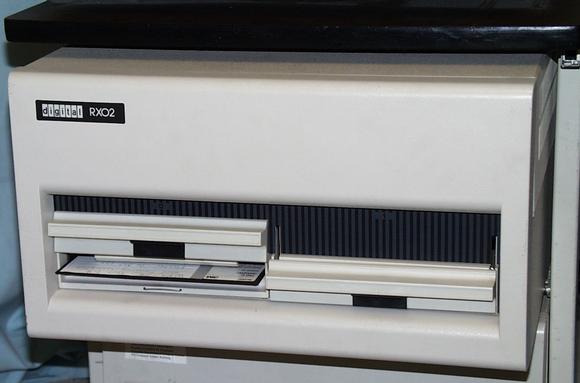
The RX01/RX02 Disk Drive a removable media 8 inch floppy drive. The RX01 was the first generation drive dating to around 1975. The RX02 was a double capacity version around 1978. The RX02 double density drive stored 256k words or 512k bytes on a disk. It can also emulate the earlier RX01 drive storing 128k words or 256k bytes. The PDP-8 normally used a RX01 or RX02 in RX01 mode. These drives were normally used with the PDP-8E type Omnibus machines or the later VT78 and Decmate machines which are more like PC's.
On the Omnibus machines it is connected to the RX8E (M8357) interface board which transferred data under program control. The board is also called the RX28E when talking to a RX02 not in RX01 compatibility mode. The drive transfers data serially to the controller card using a single sector buffer so requires a 2:1 interleave for fastest data transfer.
Unlike modern floppy drives the disk is kept spinning all the time and the heads are only brought into contact with the disk (with a loud clunk) when it wants to access the disk. The drive always records data in 8 bit bytes, the PDP-8 controller can talk to it either as an 8 bit byte device or as a 12 bit word device. It the 12 bit mode it stores half the number of words per sector so the disk capacity is reduced by one third.
The RX01 mode is compatible with IBM 3740 series drives. The RX02 mode is not compatible with other standard drives since the headers are always in single density mode but the data is written in double density mode. Also in double density mode the standard MFM encoding was modified from the standard to prevent false header detection in data.
The disks recorded by these drives seem to be quite durable, I have read many disks 10-15 years old with very few read errors. I wish the floppies on the PC's at work were as reliable.
Reference material on the RX01/RX02 PDP-8 drive.
| Specification | RX01 | RX02 double density |
| Data Transfer Rate (12 bit) | 10k words/second, 5k/second interleaved | 20k words/second, 10k/second interleaved |
| RPM | 360 | Same |
| Average Access Time | 488 millisecond (1/2 stroke) 360 (1/3) | 262 millisecond (1/3 stroke) |
| Track-to-track Move | 10 milliseconds | 6 milliseconds |
| Data Tracks | 77 | Same |
| Surfaces | 1 | Same |
| Sectors per track | 26 | Same |
| Words per sector | 64, 128 in byte mode | 128 , 256 in byte mode |
| Words per disk | 128k words, 256k in byte mode | 256k words, 512k in byte mode |
| Recording Method | FM | MFM, DEC version |
| Density | 3200 bpi (inner track) | Same |
| Tracks per inch | 48 | Same |
| Recording Media | Iron oxide disk, 8 inches in diameter | Same |
| Hard Error Rate | 1 in 10^12 bits | 1 in 10^12 bits |
| Operating Environment | Maximum: 59 to 90 F
Relative Humidity: 20 to 80 % |
Same |
| Power | 100 watts (approximate) | 225 Btu/Hr (66 watts) |
| Weight | Not specified | 55 pounds |
| Size | 19"x10.5"x21.5" (approximate) | 19"x10.5"x21.5" |
So far I have had to make four repairs to my various RX02's. The first was the drive was unreliable reading and writing disks. I found the felt pad in the arm that presses down on the disk over the head had worn flat with the plastic holder. I bought the closest felt I could at a craft store and replaced the existing felt with it. The second and third were power supply failures. In one the main pass transistor failed and in the othera zener diode failed. The last failure was another drive that was unreliable reading and writing. I traced it to the drive belt slipping so the disk was rotating below its intended speed. If you have the right equipment you can measure the rotation speed. It should be around 360 RPM. On a good drive the disk won't slow down much if you put a little drag on the big drive pulley with your finger. On this drive it would stop the disk rotation. I first cleaned the belt with some rubber rejuvenator which worked for a while. When it acted up again I cleaned it again and moved the drive motor to tighten the belt a little.
Documents related to RX01 and RX02
Current size small. Select Picture size for links below Small Medium Large
Drive Front ( 23K)
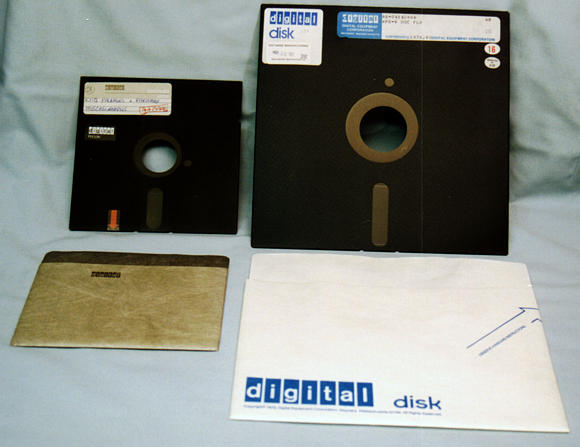
8 inch (RX02) and 5.25 inch (RX50) floppies ( 31K)
Feel free to contact me, David Gesswein djg@pdp8online.com with any questions, comments on the web site, or if you have related equipment, documentation, software etc. you are willing to part with. I am interested in anything PDP-8 related, computers, peripherals used with them, DEC or third party, or documentation.
PDP-8 Home Page PDP-8 Site Map PDP-8 Site Search